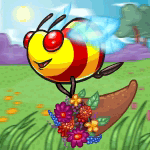
The Beekadoodles & the Buzzers: Neopian Pollinators
by Ziggs (drziggs)
--------
Professor Clodbottle here, your resident Neopian Kougra expert on petpets and petpetpets! Today I would like to discuss a very important topic to all of Neopia: pollination! Almost of all the food at the Neopian Food Shop, even at the Gourmet Club, wouldn't be possible without pollinators. Many Neopets may not realize it, but pollinators are such an essential part of the ecosystem that it would most likely collapse without our pollinating friends.
First, let's make a few things clear. What is pollination, and what is a pollinator? Pollination is the act of transferring pollen from one flower to another - it's how flowering plants make more flowering plants! Every flowering plant, from Starflowers to Fire Yooyu Flowers, requires this transferrance of pollen in order to maintain diversity. A pollinator is any petpet or P3 that transfers pollen between flowers, which usually takes place as the pollinator visits the flower for a sugary nectar treat. For example, a Beekadoodle may sip nectar from a flower, incidentally picking up pollen grains on its beak and face, and then visit another flower, depositing that pollen in the process. It's really a wonderful system!
Today I will be introducing you to the primary players in our pollination system, by which I mean the most common pollinators. Some you have probably seen flitting about the Rainbow Pool, and others are more rare, only coming out at certain times of year in the Haunted Woods. Regardless of the type, we want to respect all of our pollinators for the job they do.

Beekadoodle
Probably the most common pollinator seen in Neopia, the Beekadoodle's long, thin beak gives you a hint about how this petpet feeds from long-tubed flowers. It must stick its beak into the flower, where then it drinks nectar using a surprisingly long tongue. They are incredibly fast and efficient little flyers with a high metabolism, and so must visit a lot of flowers. Beekadoodles will often guard a flower patch and keep other Beekadoodles from entering with lots of squeaks and posturing! Try hanging a feeder in your garden and you can observe their amusing antics. Beedadoodles are especially are attracted to the color red.

Buzzer
The Buzzer is likely the second most common pollinator of all! Most Neopets gives Buzzers quite a lot of space, fearing their well-known sting. But there's nothing to worry about, Buzzers only attack if highly provoked and are actually quite gentle. In spring, a visit to the Faerieland flower fields will reveal a whole community of busy Buzzers as they go about their jobs. Buzzers are especially known for producing a very famous commodity: honey. They build elaborate hives to store it, and some Neopets have become successful rearers of Buzzers to harvest their honey. They especially are attracted to blue and purple flowers.

Flightning Bug
I bet you weren't expecting the humble Flightning Bug to also be a pollinator! These tiny Petpets are also quite efficient at transporting pollen, although they are not as big as other types. They are small but numerous in many habitats, making up for the smaller amount of pollen transported by their sheer numbers. They surprisingly can migrate very far distances, so are especially useful for transporting pollen to new areas of flowers. Flightning Bugs are attracted to flowers with very strong smells that are not especially favorable to most Neopets.

Flosset
A resident of Faerieland, the cute Flosset can be seen gently floating among the fields and visiting flowers. As they are covered in a fine blue fur, a lot of pollen can stick to their bodies easily - sometimes they look more yellow than blue! Not known for flying very far distances, Flossets instead excel at short-distance pollination and ensure local populations receive abundant pollen grains. They are attracted to pink colored flowers.

Carmariller
Another well-known resident of Faerieland, the Carmariller is known for its beautiful and intricate wing patterns. It is a gentle flyer but can surprisingly move quite long distances. It gently flits from flower to flower in the spring and summer. Many Neopians plant special flowers specifically to attract it, as it is quite popular for its beauty among gardeners. They are especially sensitive to cold and may not come out if its a long and difficult winter. Carmarillers prefer yellow and orange flowers, especially those with a large 'landing pad' that they can rest on while drinking.

Batterfly
If you visit the Haunted Woods during the late summer, you may come across an especially rare site. There are unique cacti that grow at the edge of the Woods and produce beautiful white flowers only after a seasonal rain. Interestingly, these flowers only open at night. That's because nighttime is when their primary pollinator, the Batterfly, is active! Unknown to many, Batterflies are extraordinary in achieving hovering flight, and visit flowers at night using their long tongue to reach the nectar. As they are covered in fur, they can carry huge amounts of pollen around. Batterflies are attracted to large, white flowers.

Gratlik
While less well-known as pollinators, Gratliks are rather clumsy Petpets that nevertheless visit flowers and transport pollen. They are quite hardy and can survive well in a number of environments - I myself have an inordinate fondness for this group of Petpets! As a result, they can travel farther distances. However, they are clumsy in flight and miss their landing. That's no problem for the flower usually, as their bumbling just means the Gratlik becomes covered in even more pollen. Gratliks are considered to have a very old relationship with flowering plants and can be traced back to prehistoric times in Tyrannia.

Teasqito
You may find the Teasqito annoying with its constant buzzing by your ear, but like all else, it also plays an important role. Its large eyes allow it to see bright flowers even from far distances. The long antenane are also very sensitive to floral scents, allowing it to key in on a flower's location. The yellow body provides some camouflage as it visits flowers, and it blends in very easily. The Teasqito is a well-known visitor to fields where tea leaves are grown, and it pollinates these important plants. It's also known the collect the leaves sometimes for eating or for lining its nest.

Springabee
Of course, Petpets are not the only pollinators in Neopia! P3s are also abundant and efficient flower-visitors if you know to look for them. Unsurprisingly, the Springabee is one of the most well-studied, as its behavior is closely related to that of the Buzzer - some researchers even think they are related! Like the Buzzer, it also possesses a stinger and black and yellow warning coloration. But it is still a welcome site among many farmers, as it is known to pollinate crops like tomatoes and blueberries in Meridell Orchard.

Veespa
The Veespa is often feared among Neopets for what some think is an aggressive personality. However, this is much misconstrued and the Veespa is just as important a pollinator as any other. It's important to learn to respect our P3 neighbors and recognize their important roles in Neopia. It behaves much like the Springabee and also has a stinger and unique coloring. Vespa visit flowers all over Neopia and can live in unique paper nests that they build themselves. Some Veespa are also carnivorous as well and may take care of pests such as other P3s.
I hope you have learned something new by reading this. Are you ready to respect the native pollinators of Neopia? If you are interested, I would recommend a P3 net and viewing cage, along with a magnifying glass, in order to observe your local neighbors. As always, leave no trace when you're out in the wild. I hope I have convinced you to take a new look at the small life around Neopia. Always remember to respect Neopian nature!
|

